Ice Cream for Bears Butterbear Falls Short

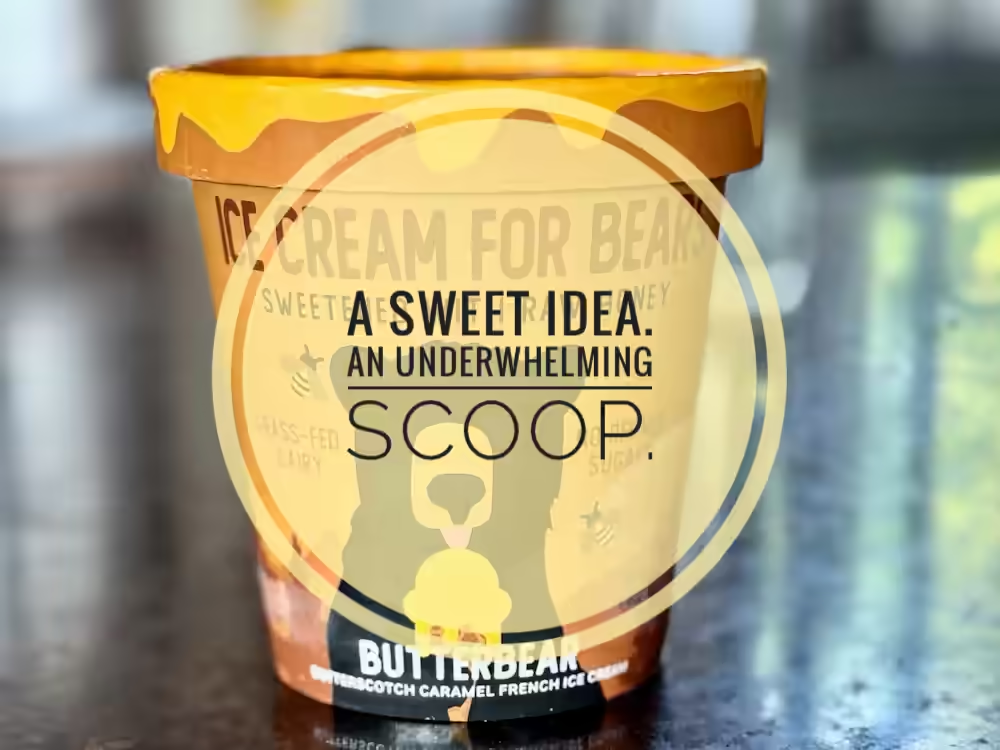
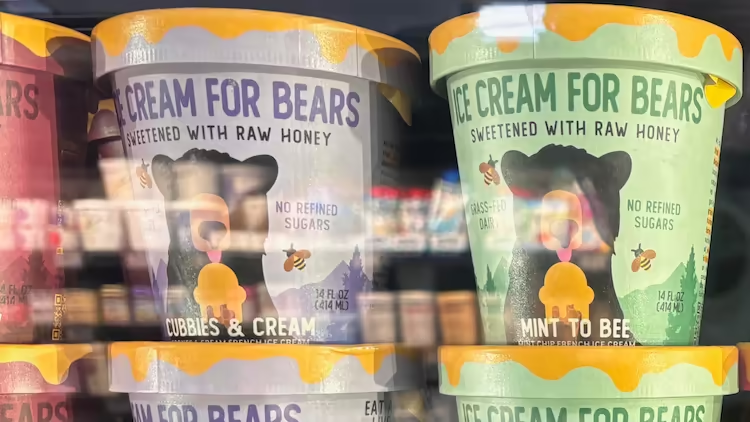
I recently saw Ice Cream for Bears in the freezer section. Between the packaging and the concept, I was instantly intrigued.
And so I took a plunge and tried their Butterbear flavor recently and it was…fine. If you’re not familiar, its selling point is that it’s fully sweetened with honey and contains no refined sugars.
This premise had me excited, not so much for the potential health benefits of eating honey instead of refined sugar, but for the flavor.
Before going any further, I want to clarify that this isn’t a “bad” product. It’s simply not as good as it could be and I’m not sure it’s worth the money ($8 per 414 mL “pint”—roughly 60 mL less than a true U.S. liquid pint, or the equivalent of $9.14 per pint1).
Ultimately, Butterbear fell short for two main reasons: the ice cream had an unexpectedly coarse texture, and its butterscotch-caramel flavor was far too mild for an $8 premium ice cream.
An Unexpectedly Coarse Texture
For some reason, this ice cream had an unusual and unexpectedly coarse texture—a coarseness highly reminiscent of honey that has crystallized2. The ice cream itself wasn’t icy; it simply lacked smoothness. This is not something I would expect from a “pint” of ice cream, whether it costs $8 or even just $5.
UPDATE: I didn’t encounter this coarseness with ICB’s Chocturnal chocolate ice cream, so I suspect the issue with Butterbear was a one-off. Still, it’s a problem I’ve never encountered before, and it made an underwhelming ice cream less enjoyable.
It Doesn’t Quite Taste Like the Real Thing
Even if this ice cream didn’t have coarseness, the flavor would still be pretty underwhelming and nondescript. It tastes vaguely like butterscotch and caramel but, unlike other premium ice creams (that cost the same if not less), it doesn’t taste prominently like either of those.
I don’t need my food to hit me over the head with flavor, but I do need it to taste noticeably like its advertised flavor. This ice cream doesn’t do that.
Natural Flavors May Be Part of the Problem
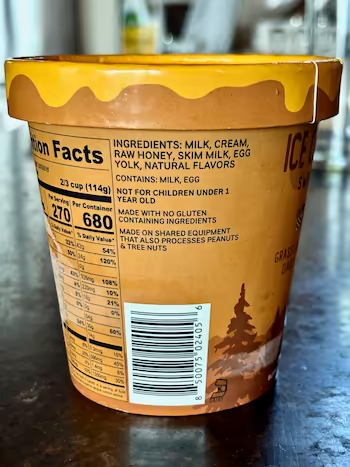
Part of the problem may lie in the use of only natural flavors for Butterbear. Natural flavors are not inherently inferior, and they are widely used in commercial food production. The problem is not their presence; it is the flavor used in Butterbear: it does not create a convincing or memorable butterscotch-caramel flavor.
Think of it like this: a vanilla ice cream made with natural flavor may not taste as much like real vanilla as ice cream with vanilla extract or vanilla beans. In Butterbear, I can’t help but think that using natural flavors instead of actual caramel and butterscotch holds this ice cream back.
No Caramel, No Butterscotch, No Help
Another reason the flavor is “meh” is likely because the ice cream doesn’t contain any swirls of butterscotch or caramel. I don’t need ice cream to have swirls but, man, they can sure go a long way towards amping up the flavor.
This is especially true if a company is relying on natural flavors for the ice cream base: having the “real thing” can help offset the character of natural flavors.
If I had to guess, this was done to balance out the cost of goods sold: honey is not cheap, and so ICB probably had to compromise by not including mixed-in butterscotch and caramel.
And yet ICB makes plenty of other mix-ins without refined sugar: the cookies in Cubbies & Cream are sweetened with dates; and the cookie dough in Dough Bear is also made with dates. Also, ICB makes hot fudge that’s sweetened with honey, along with “caramel dunes” made with caramel sweetened with honey, dates, and no refined sugar. Clearly it’s within ICB’s reach to have added caramel to this ice cream!
Given that ICB has already figured out how to make date-sweetened caramel—and sells products containing it—I’m not sure why Butterbear doesn’t include a swirl of its own. My best guess is still cost but, at $8 per “pint”, that compromise is difficult to overlook.
UPDATE: Between the time of writing this review and publishing it, Ice Cream for Bears appears to have discontinued Butterbear and replaced it with Salted Caramaul. Unlike Butterbear, Salted Caramel is made without natural flavors. I have not tried Salted Caramaul, so this review applies only to Butterbear.
So, What’s the Point of the Honey?
What I’m left wondering is “why honey”, especially since it doesn’t taste noticeably like honey.
Well, according to the “Why we use honey” portion of ICB’s website, “Unlike modern ultra-processed sugars, honey is an unrefined sweetener that our bodies have evolved to process over thousands of years.” In other words, the honey isn’t there for flavor, it’s for potential health benefits.
This is where I become skeptical. Even if we assume that there are health advantages to consuming honey instead of refined sugar, Butterbear is still a dessert rich in sugar and fat. Honey may contribute trace nutrients, but it does not transform ice cream into a truly healthier option—any marginal nutritional advantage is outweighed by the unhealthiness of ice cream.
More importantly, any nutritional advantage should be weighed against the actual experience of eating the product. I’m not interested in choosing an ice cream that may be only marginally better for me if it tastes noticeably less good.
Is Butterbear Worth $8?
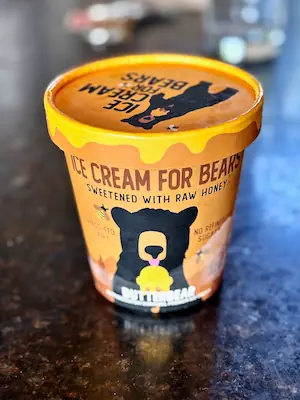
Butterbear is not bad ice cream. I finished the container and generally enjoyed eating it. But “not bad” is a low bar for a premium product that costs $8.
Even if I treat the coarse texture as a one-off defect, this flavor remains difficult to recommend. Simply put, the butterscotch-caramel character is so mild that Butterbear ranks among the least exciting premium ice creams I’ve tried.
I understand the appeal of choosing a honey-sweetened ice cream over one made with refined sugar, especially when the two products are otherwise equally enjoyable. But that is not the choice Butterbear presents. Here, the possible nutritional advantage comes with a noticeable sacrifice in flavor.
My goal with The Snacks Guy is to celebrate great snacks, not to pile on products that fall short. I’ve tried to be fair and even-handed in my assessment of Butterbear, but between the price and the underwhelming experience, I think its shortcomings are worth pointing out.
Ice cream is a treat. Within that context, I’m not willing to trade enjoyment for health benefits that are marginal at best. With so many flavorful options available for the same price—or less—I would not buy Butterbear again.
- The Ice Cream for Bears website very clearly states that its ice cream is both 414 mL and 1 pint, despite the fact that a U.S. liquid pint is 473 mL—a difference of 12.5%. ↩︎
- It’s worth noting that honey naturally crystallizes over time. There isn’t enough information to conclude that crystallized honey caused Butterbear’s coarseness, but it could plausibly explain the texture. ↩︎